
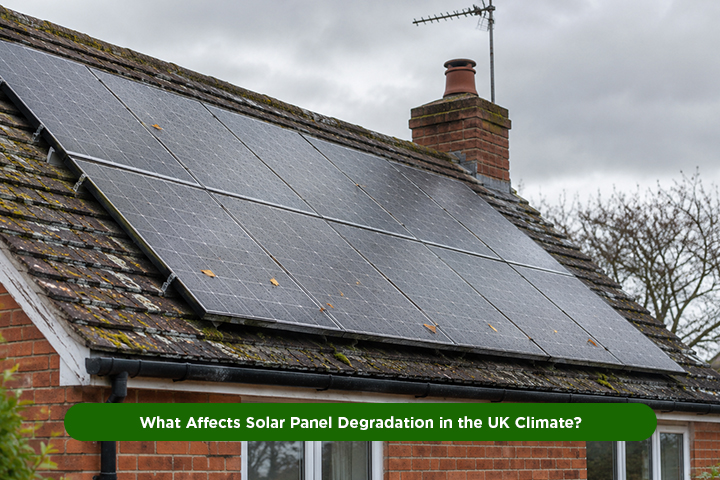
Solar panels have been engineered to deliver power for many years, but their performance gradually decreases due to a process known as solar panel degradation. In the United Kingdom, solar panels are influenced by temperature, rainfall, winds and sunlight, although all those factors rarely result in sharp performance deterioration. Modern panels can last up to 25-30 years.
Good quality panels usually degrade by about 0.3-0.5 per cent a year. By the end of the 10th year of their use, they will be delivering only 95-90 per cent of initial energy and by the 25th year—about 85-90 per cent.
Knowing about the degradation process will allow home owners to make better-informed decisions regarding their investment in solar energy production. This guide will talk about reasons for degradation, influence of UK climate on solar panels, panel performance and other topics.
What Is Solar Panel Degradation?
Solar panel degradation refers to the loss of electricity production over time. Occurs upon exposure of the panels to the environment and sunlight. Solar cells are made of materials that can “change” sun light into electricity. During operation these materials undergo a slow physical and electrical change.
As a result, panels may produce slightly less electricity each year. However, degradation does not mean panels stop working.
It is essential that two different measurements be understood:
- Efficiency: The ability of a panel to use the sun’s energy to generate electric power.
- Output: The amount of electricity that a solar panel generates over time.
Both measurements can vary with age of panel. But the electricity generation is also dependent on weather, shading and installation conditions.
What Causes Solar Panel Degradation in the UK?
UK weather creates several conditions that can influence solar panel performance. Some affect the panels directly, while others damage their electrical connections.
1. Temperature Changes Throughout the Year
The temperature in the UK varies significantly from summer to winter. During these seasons solar panels are subjected to alternating heating and cooling multiple times. Materials expand with increased temperature, and contract with a decrease in temperature. Frequent vibration may stress the electronic connections and materials of panels.
This stress may eventually cause small cracks or connection problems. However, quality panels can tolerate typical outdoor conditions.
2. Rain, Moisture and Humidity
There is widespread rainfall in the UK. Typically it will dislodge dust and loose dirt from solar panels. But moisture can be an issue if the panel seals fail. Damaged parts can become corroded or cause electrical problems when they are wet.
These issues can be avoided by correct installation and quality materials. Also, periodic checks may reveal damaged seals and connections.
3. Strong Winds and Storms
Strong winds are a threat to the UK, especially in autumn and winter. In extreme weather conditions, poorly secured panels can move even more. This action may strain mounting components and electrical connections. Other debris in flight can also cause damage to the surfaces of the panels.
These risks are lessened with professional installation. Installers should inspect the roof surface and appropriate mounting prior to installation.
4. Ultraviolet Sunlight Exposure
During their life, solar panels are exposed to ultraviolet radiation. The long-term exposure will cause the protective materials to be affected gradually. This could lead to discolouration, material deterioration or decreased protection. These effects can be minimized by using quality panel construction.
5. Shading and Dirt Build-Up
Partial shading may be due to trees and nearby buildings and chimneys. Soil, leaves and bird droppings are other things that can hinder sunlight. These problems are not necessarily permanent degradation, but they do decrease the amount of electricity generated. Restored output through cleaning and shading management.
Is Your Electric Bill Too Heavy on Your Budget?
Stop paying full price for your bills when the power from the sun can save your money. A high efficiency solar PV system, built for UK weather, could save you up to £550 a year.
What Is a Good Degradation Rate for Solar Panels?
A typical degradation rate for a solar panel is < 0.5 per annum. Lower rates result in panels having greater electricity generation capacity for a longer period of time.
There are several factors which affect the annual degradation of the solar panel:
- Panel technology and manufacturing quality.
- How to install and the conditions for mounting.
- Temperature, humidity and ultra-violet exposure.
- Material quality and protective layers.
The National Renewable Energy Laboratory (NREL) studied almost 2,000 degradation measurements. It claimed a median degradation rate of around 0.5% a year.
For UK homeowners, these figures offer a useful comparison. However, manufacturers’ specifications should guide individual purchasing decisions.
Solar Panel Degradation Rate Per Year UK
The annual degradation of most modern crystalline silicon panels is relatively low. The use of a rate of 0.3% to 0.5% is a good buyer’s indicator. Certain panels could work better in optimum conditions. Others are likely to have greater losses caused by material faults or environmental stress.
There is not one single degradation rate for the UK. Actual performance is affected by local weather, roof conditions and panel construction.
How Much Do Solar Panels Degrade Over 10 Years?
Solar panels degrade at a certain rate per year. This diminishment gradually takes a toll on their energy generation capability. Imagine having a panel that has a 0.4% degradation per year. After 10 years it would be around 96% of its original production.
For instance, a single 400W panel would have around 384W remaining. This is its estimated capacity when tested normally. But higher degradation rates might lead to a decrease in the capacity of panels. That means comparing annual rates will help in forecasting future performance.
What Is Solar Panel Efficiency After 25 Years?
Most quality solar panels continue producing electricity after 25 years. However, their output will usually be lower than originally rated. Many manufacturers guarantee approximately 80% to 85% remaining output. Some premium products offer higher guaranteed performance.
For instance, a 400W panel with 85% capacity would produce 340W. This is a typical power rating, not an actual power generation figure per day. This is because the electricity produced in the real-world depends on sunlight and installation conditions. Other aspects such as shading and orientation of the seasonal weather also influence generation.
What Is the Expected Solar Panel Output After 30 Years?
Solar panels can be used past their warranty, which is typically the standard 25 years. Numerous systems are still effective after 30 years. The rest of their output is based on the degradation rate that they had originally. Here are some examples for a 400W panel:
…
Illustrative compound-degradation calculations. Actual performance will vary based on operating conditions and panel. These estimates illustrate the importance of reducing degradation. Annual variations, no matter how minor, have a significant impact on electricity generation.
However, lower panel output does not automatically mean system failure. A properly maintained system can continue providing useful electricity.
N-Type vs P-Type Solar Panel Degradation
There are various semiconductor material and cell structures used in solar panels. These designs can impact efficiency, durability and long-term performance. There are two types of Silicon cells: N-type and P-type.
P-Type Solar Panels
P-type panels commonly use PERC cell technology. They have been widely used in residential solar installations.
Their main characteristics include:
- Established manufacturing processes.
- Generally competitive purchase prices.
- Proven performance across many installations.
- Potential sensitivity to light-induced degradation.
N-Type Solar Panels
N-type panels include TOPCon and HJT technologies. They are widely used in newer, high-efficiency solar products.
Their potential benefits include:
- Strong resistance to boron-oxygen-related LID.
- High conversion efficiency.
- Good performance at higher temperatures.
- Potentially lower long-term degradation.
But in all conditions N-type panels are not always the best. The production of quality materials and protective materials is still of significance.
N-Type TOPCon and HJT Degradation Rates in 2026
There are two key N-type solar technologies, both being TOPCon and HJT. Both provide decent performance, though there are variations in reliability. The annual degradation rate is not the same for either technology. There are variations in cell design, encapsulants and protective materials used by manufacturers.
Kiwa PVEL’s 2025 reliability testing identified important differences between technologies. Its UV-induced degradation testing reported median losses of 3.1% for TOPCon. The 4.2% figure was achieved by HJT, and the 2.2% was achieved by PERC. These are calculated UV test losses, not annual losses. They cannot be directly assumed as a predictor of 25 year performance.
But there are also differences between individual manufacturers in 2026. A comparative study was recently conducted and it has been shown that there are differences between TOPCon, HJT and PERC modules. Thus, home owners should check the independent reliability tests. It is also essential to review the true manufacturer’s performance warranty.
What Is Light-Induced Degradation (LID) in Solar Panels?
Light-Induced Degradation (LID) occurs when solar panels are first exposed to sunlight. Can shorten its life cycle when it comes to generating electricity. This effect typically happens in the first few months of running. The reduction varies from cell to cell, depending on the materials used in producing the solar cells and the process.
What Causes LID?
Boron and oxygen impurities can be present in the traditional P-type silicon cells. These materials can create electrical defects when they are exposed to sunlight. These faults decrease the electricity generation capacity of the panel. However, the effect usually stabilises after the initial exposure period.
Modern N-type cells generally resist traditional boron-oxygen-related LID. But they can suffer from other types of photo-degradation. Light and elevated temperature induced degradation (LeTID) is a degradation that occurs in some panels due to operating temperatures and light. This can cause additional performance losses under certain conditions.
Linear Performance Warranty vs Product Warranty
There are typically two types of warranties offered by solar panel manufacturers. Each service safeguards homeowners against various issues. When comparing solar panel manufacturers, knowledge of their differences is important.
1. Product Warranty
Product warranty is for materials and manufacturing defect. It will help prevent some issues related to panel construction and operation. For instance, it can apply to faulty connections or delamination. Some warranties last longer than others and some warranties last longer than a specific product.
Some manufacturers offer product warranties lasting 15 to 25 years. Others provide longer coverage on selected panel ranges.
2. Linear Performance Warranty
Linear performance warranty ensures the electricity-generating capability of the panel. It establishes a minimum production amount for a specific duration of time. A manufacturer could, for instance, offer a 25 year warranty for 87% output. This implies that the panel should have at least this capacity.
A few manufacturers will extend the warranties to 30 years. Always check the guaranteed output at the last warranty year.
What Should Homeowners Check Before Buying?
Before choosing solar panels, be sure to verify these details:
- Warranty length: Make sure that they offer a product warranty as well as a performance warranty.
- Annual degradation: Check if there is a clear annual decrease.
- Final output: Get a comparison of guaranteed capacity after 25 or 30 years.
- First-year reduction: See if the warrant is for initial degradation.
- Warranty provider: Ensure that they are the ones who cover claims and replacement.
- Warranty conditions: Check exclusions, installation guidelines and claim requirements.
A longer warranty does not always mean better protection. The manufacturer’s financial stability and claim process also matter.
How Can UK Homeowners Reduce Solar Panel Degradation?
Natural degradation cannot be completely avoided. But with proper equipment and maintenance, system performance can be maintained.
Here are some practical steps for homeowners:
- Choose reliable panels: Check independent test data and specifications from the manufacturer.
- Use qualified installers: Ensure proper mounting, wiring and electrical connections; use qualified installers.
- Check roof conditions: Make sure the roof can support the installation.
- Monitor electricity generation: Ensure roof structure is capable of supporting installation.
- Keep panels clean: Make sure to remove excess dirt and bird droppings as needed.
- Inspect electrical components: Ask professionals to investigate unusual performance changes.
- Check inverter performance: Replace faulty equipment when necessary.
Professional inspections can identify developing problems. They also help prevent minor faults from affecting overall generation.
For homeowners considering a new system, explore these related services:
These pages can help readers explore suitable installation, maintenance and storage options.
Final Thoughts
Solar panel degradation is a normal phenomenon that happens to all solar installations. But these new panels can keep working for decades. The durability of a panel can be affected by UK weather conditions such as temperature and moisture. With the assistance of good materials and professional installation, there will be less potential damage.
Opt for panels with low degradation rates to ensure optimal performance over time. Warranties are also a reason that homeowners compare homes when purchasing a new house. A solar installation that is dependable is a lot more than just solar output today. It’s a matter of ensuring the secure generation of electricity over the long term.
Final Thoughts
Get Your ECO4 Grant
Simply enter your postal code and answer a few questions, we’ll handle the rest!
Recent Blogs
Share Blog